Archive

feedback

ABOUT

Memory’ is an interactive installation and consists of merely a tablet equipped with a camera, custom software and a wooden frame. Programmed to recognise human faces, the installation saves the faces of its spectators and then superimposes them endlessly. The displayed result is an ‘average’ face, calculated from all the faces it has seen and thereby a visualisation of the history of all the people that stood still to take a look at it.

CREATOR

The maker and creator of the project is Korean studio SSBKYH, consisting of Shin Seung Back and Kim Yong Hun. Their collaborative practice explores social and cultural impacts of technology.

RULES / RESTRICTIONS

There is only one interactive portrait which captures the results, but everyone is allowed to participate. The only requirement is to look at it with your face. In order to be able to create the ‘average’ face, the ideal approach would be to let people participate only once; however, it is unclear if this is an official rule for the project.

COMMENTS

Intriguing and funny; but I would like to know in which countries the portrait has been exhibited. It would be interesting to understand which regions are responsible for creating the ‘average’ face. What if every continent had its own ‘Memory’ portrait?

ABOUT

In order to become a more ‘human-oriented’ brand, Volvo has launched a Facebook application called You Inside.The crowdsourcing application enables fans to post images of the things they keep inside their cars along with info about their vehicles and lifestyles. Volvo analyses the information and delivers a personality profile, with users able to dip into other’s You Inside profiles too. Data gathered by the app on the social network will be fed into research for vehicle development at Volvo.

CREATOR

The campaign/platform has been launched by Volvo itself on Facebook, where the users contribute to the collection by sharing data. Volvo uses the data to create a collective collection.

What makes Volvo Cars unique in the automotive world is its focus on human values in life. Caring about yourself and others; the safety concept encompasses not only the passengers of the car, but also passengers in other cars, and pedestrians. Environmental care goes beyond legislation – and consideration for customers shall imbue the entire company.

RULES / RESTRICTIONS

The user data is limited to their own lifestyle and physical or practical automobile assets, usage and information. The platform operates on Facebook only, so the users need a Facebook account and must agree to their data being shared with others and being used by Volvo for their market and research goals.

COMMENTS

Certain privacy questions arise with this project and it makes me wonder what kind of policy Volvo manages when processing user data. However, I like the philosophy of Volvo for focusing on the personal human experience and their willingness to be actively involved with improving this.

ABOUT

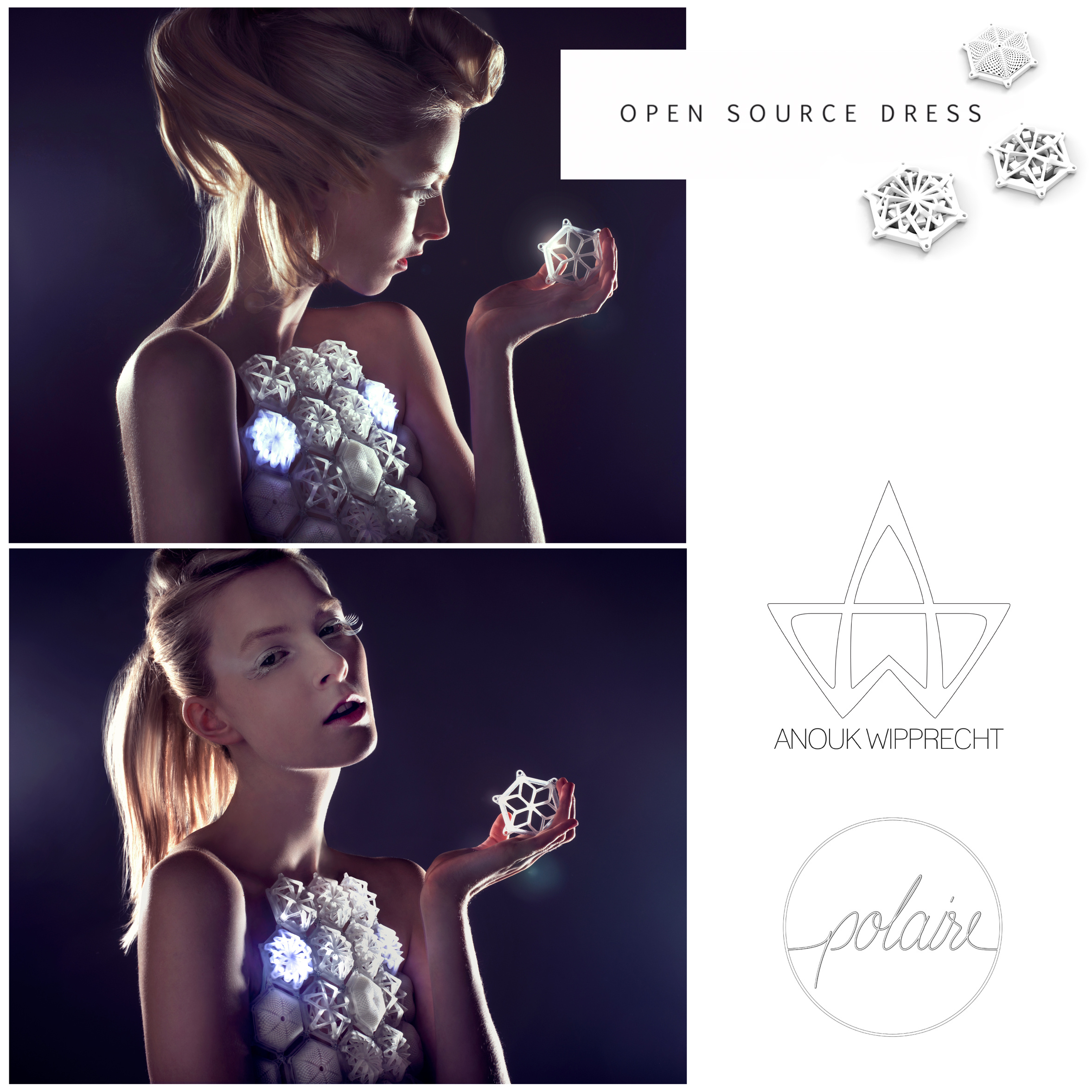
The Open Source Element Dress is a dress created by the public. This project is an open call for anyone who has a bit of inspiration to contribute elements called “particles” that will be united on the dress through a connecting mechanism.

CREATOR

Anouk Wipprecht is a Dutch based fashiontech designer. She creates technological couture; with ‘host’ systems around the human body, her designs move, breath, and react to the environment around them.
Her target audience is everyone who is interested in the idea and is willing to contribute to it.

RULES / RESTRICTIONS

People can submit personalized particle designs that must be 62 mm wide. They need to use a TINKERCAD template to create these particles. Of these particles, 150 will make it into the final piece of clothing, to be completed by September 13th.

COMMENTS

I think Wipprecht already took the words right out of my mouth: “Why would we wait for that one awesome 3D printed dress that ’embodies the future’ to be presented and pushed upon us to adore? Why not all make that one dress that represents a possible future—not designed from the hand of one designer, but with the world.”

LINKS

http://www.materialise.com/blog/design-part-anouk-wipprechts-open-source-dress/

Design a site like this with WordPress.com
Get started